
Technology
Product Designers: How Strategic Material Selection in Sheet Metal Avoids 40% Cost Overruns

Introduction
A common and costly scenario unfolds in product development: an expensive aluminum alloy is selected for lightweighting, only to cause skyrocketing scrap rates due to poor formability in mass production. Conversely, choosing low-cost carbon steel can lead to a massive product recall a year later from corrosion failures. These cost overruns, delays, and brand damage, originating from flawed material selection mistakes, are often embedded early in design but erupt at a multiple of the cost later.
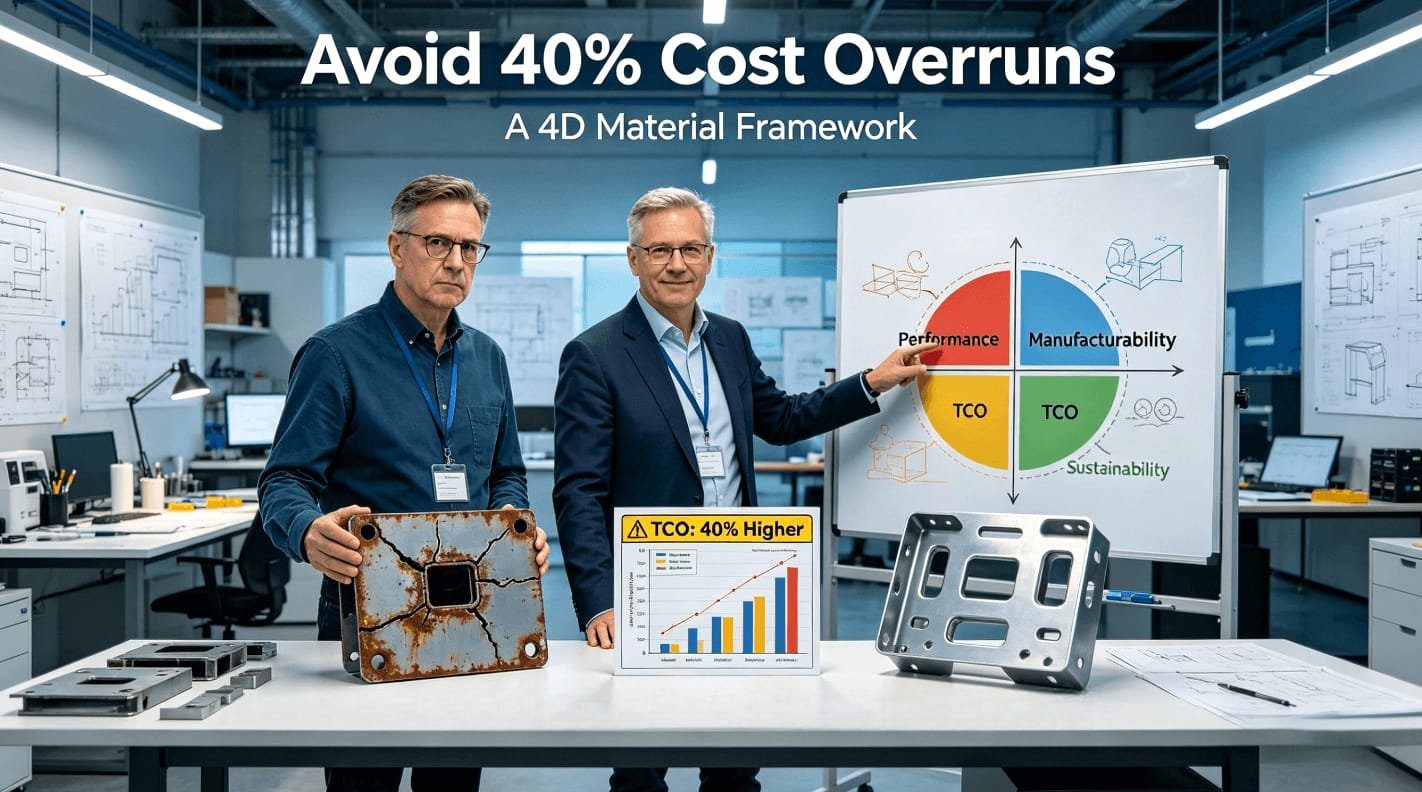
The core issue is treating material choice as an isolated decision based on limited property charts, like yield strength. This overlooks the critical interaction between the material and sheet metal forming processes (bend radii, springback), the Total Cost of Ownership (including processing, finishing, maintenance), and the growing demands of environmental regulations and sustainability. This article presents a four-dimensional material selection framework that integrates mechanical performance, manufacturability, cost, and environmental footprint into a unified decision model. By applying this framework, designers can transform material decisions from passive specification matching into an active tool for value engineering and risk management, systematically avoiding hidden cost traps.
Why Does Choosing the Wrong Sheet Metal Material Inevitably Lead to Cost Overruns and Performance Failures?
The selection of an inappropriate sheet metal fabrication material triggers a cascade of direct and indirect costs that extend far beyond the price per kilogram. These failures manifest not only as immediate scrap but as chronic issues in production efficiency, product reliability, and long-term brand liability. Understanding these failure modes is the first step in building a resilient, cost-effective design strategy for any sheet metal fabrication services project.
1. The High Cost of Poor Formability and Fabrication Defects
Selecting a material with inadequate formability for the intended geometry leads directly to production defects. A metal that cracks during deep drawing or exhibits excessive springback during bending creates unusable parts. Beyond the raw material waste, this forces costly adjustments: tooling modifications, slower production speeds, and increased manual inspection. For a stamped chassis, the cost to rework or replace hardened forming dies can consume 20% or more of the total project budget, a devastating overrun that could have been prevented with proper material science input during DFM.
2. Early-Life Failures and the Liability of Inadequate Performance
A material that fails to meet the operational environment’s demands creates a long-tail financial risk. Carbon steel used in a humid environment without sufficient corrosion protection will rust, leading to premature product failure, warranty claims, and potential safety recalls. The cost of a recall — including replacement parts, logistics, and brand reputation damage — can dwarf the initial savings from choosing a cheaper material. This highlights that material cost is not just a line item on a BOM, but a direct determinant of product lifecycle reliability and total ownership cost.
3. The Hidden Tax of Poor Weldability and Secondary Processing
Some materials, like certain high-strength steels or aluminum alloys, are notoriously difficult to weld or finish. Poor weldability leads to weak joints, requiring expensive post-weld heat treatment or non-destructive testing. A material incompatible with standard powder coating or anodizing processes may force the use of a premium, low-volume finish at 3-5 times the cost. These “hidden” costs in secondary and tertiary processing are where material selection truly impacts the bottom line, making collaboration with a knowledgeable sheet metal fabrication services partner essential from the outset.
Beyond Strength and Cost: What Are the 4 Critical Dimensions of Modern Material Selection?
Moving beyond simplistic strength-versus-cost trade-offs requires a holistic framework. The modern four-dimensional material selection model forces designers to evaluate mechanical performance, manufacturability, Total Cost of Ownership (TCO), and sustainability as interdependent, equally critical factors. This systematic approach, supported by tools like Granta Design’s CES EduPack, transforms material choice from a guess into a quantifiably optimized engineering decision.
1. Dimension 1: Mechanical & Physical Performance
This is the traditional starting point, but it must be interrogated deeply. Beyond basic tensile strength, consider fatigue strength for cyclically loaded brackets, thermal conductivity for heat sinks, or electromagnetic shielding for enclosures. The key is defining the primary functional driver of the part. A Material Innovation that offers a 20% higher strength-to-weight ratio might justify a higher cost if it enables significant system-level weight savings, as in automotive or aerospace applications.
2. Dimension 2: Manufacturability & Process Compatibility
A material’s theoretical properties are meaningless if they cannot be reliably realized in production. This dimension assesses formability limits (via Forming Limit Diagrams), weldability and brazeability, and compatibility with intended surface finishes. A high-strength aluminum might be perfect on paper, but if it requires specialized, slow welding techniques, it could destroy production line takt time. A professional sheet metal material selection guide will map materials to their optimal fabrication processes.
3. Dimension 3: Total Cost of Ownership (TCO)
TCO moves past unit price to include all costs from cradle to grave. This includes raw material, processing difficulty (machining time, tool wear), energy consumption during forming, finishing costs, expected maintenance, and end-of-life recycling or disposal. A cheaper material that causes 10% higher scrap rates and requires a costly coating may have a much higher TCO than a more expensive, but more process-friendly and durable alternative.
4. Dimension 4: Sustainability & Environmental Footprint
This is now a non-negotiable dimension for most industries. It evaluates the material’s recycled content, the carbon footprint of its production, its longevity, and its ease of recycling at end-of-life. Regulations and consumer preferences are increasingly mandating this analysis. Sustainable choices are no longer just ethical; they are becoming a source of competitive advantage and compliance, influencing material availability and cost in the long term.
Case Study: How a Switch to Advanced High-Strength Steel (AHSS) Reduced Weight by 25% and Total Cost by 15%.
Theory is proven in practice. Consider a commercial vehicle manufacturer redesigning a structural support bracket. The original part used a traditional High-Strength Low-Alloy (HSLA) steel. By applying the four-dimensional framework, the team evaluated Advanced High-Strength Steel (AHSS), demonstrating how a strategic material substitution can deliver simultaneous performance gains and cost savings, a hallmark of true Advanced Manufacturing.
Can “Sustainable” Materials Like Recycled Aluminum Truly Compete with Traditional Options on Performance and Cost?
The perception of a mandatory “green premium” is rapidly becoming outdated. Sustainable materials, such as recycled-content aluminum and low-carbon steel, are now engineered to meet stringent performance specifications while often offering compelling economic and environmental benefits. Data from industry bodies like the Aluminum Association shows that with advancements in sorting and refining, recycled aluminum can achieve mechanical properties nearly identical to primary aluminum, with a fraction of the embodied energy.
1. Closing the Performance Gap: The New Generation of Recycled Alloys
Modern recycled aluminum alloys (e.g., 5xxx and 6xxx series with high post-consumer content) undergo sophisticated melt treatment and alloying to control impurity levels. The result is material that meets standard strength, formability, and anodizing quality specifications for a wide range of applications. For many sheet metal fabrication for custom parts projects, especially in consumer electronics and automotive, specifying recycled-content aluminum is now a performance-neutral choice that significantly reduces the part’s carbon footprint without compromise.
2. The Evolving Economics of Sustainable Sourcing
The cost dynamics are shifting. As demand for sustainable materials grows and collection infrastructure improves, economies of scale are reducing premiums. Furthermore, carbon pricing mechanisms and corporate sustainability mandates are making low-footprint materials more financially attractive. When evaluating Total Cost of Ownership, factors like potential tax incentives, enhanced brand value, and compliance with future regulations make sustainable materials a strategically sound investment, not just an ethical one.
3. Beyond Aluminum: The Expanding Palette of Green Options
The movement extends beyond aluminum. Low-carbon steels produced via electric arc furnaces, bio-based polymer coatings, and steels with reduced rare-earth elements are entering the mainstream. A forward-thinking sheet metal fabrication services partner will have access to and knowledge of this evolving material landscape. They can guide designers on when a sustainable alternative is a drop-in replacement and when it requires slight design or process adjustments, enabling innovation that is both responsible and competitive.
How Does Digital Fabrication (IoT, AI) Enable More Precise and Agile Material Utilization?
The rise of Smart Manufacturing and Digital Fabrication technologies provides unprecedented tools to de-risk material selection and maximize its value. Internet of Things (IoT) sensors, Artificial Intelligence (AI) algorithms, and digital twin simulations are moving material science from the lab onto the shop floor, enabling a data-driven, adaptive approach to working with every sheet of metal.
What Should a World-Class Sheet Metal Fabrication Partner Bring Beyond Cutting and Bending Machines?
In the era of strategic material selection, a manufacturing partner’s value is defined not by its machine list, but by its integrated engineering capabilities. A world-class partner acts as an extension of your design team, bringing material science expertise, systemic quality assurance, and data-driven insights to the table. This transforms the relationship from transactional machining to a co-engineering partnership for Custom Fabrication success.
1. Deep Material Science and Proactive DFM Collaboration
The ideal partner employs metallurgical and materials engineers who engage during the design phase. They don’t just accept a material spec; they question it. Could a different temper of aluminum avoid stress corrosion cracking? Would a pre-galvanized steel eliminate a painting step? This proactive DFM guidance, rooted in material science, is where the greatest cost avoidance occurs. They help optimize designs for both performance and the realities of sheet metal fabrication services, ensuring the selected material can be transformed into the part efficiently and reliably.
2. Certifications as a Guarantee of Process and Traceability Rigor
Certifications like IATF 16949 and ISO 14001 are non-negotiable. IATF 16949 mandates full material traceability from the mill certificate to the finished part, a critical requirement for managing risk and quality. ISO 14001 demonstrates a commitment to environmental management, assuring that sustainable material choices are handled responsibly throughout the process. These systems provide the structured framework that turns material selection strategy into repeatable, auditable reality.
3. A Data-Rich Ecosystem for Continuous Optimization
A leading partner operates a data-rich manufacturing ecosystem. They should provide not just parts, but data: SPC charts for critical dimensions, material utilization reports, and historical performance data for different materials on similar geometries. This allows for continuous refinement of the material selection model. Partnering with a sheet metal fabrication services provider that leverages this data empowers you to make increasingly informed, low-risk, high-value material decisions for every subsequent project.
Conclusion
In today’s complex product landscape, sheet metal material selection is a multidimensional strategic decision, not a clerical task. By adopting a systematic framework that balances performance, manufacturability, total cost, and sustainability, product teams can transform materials from a constraint into a source of competitive advantage. This disciplined approach prevents costly overruns, unlocks innovation, and drives true value optimization. It requires moving beyond data sheets and engaging with manufacturing partners who bring engineering depth, systemic quality, and a partnership mindset to the table.
FAQs
Q: Is stainless steel always the best choice for corrosion resistance?
A. Not necessarily. While excellent, stainless steel (304, 316) is more expensive and harder to form. For many applications, carbon steel with a proper protective coating (powder coating, galvanizing) offers sufficient durability at a lower Total Cost of Ownership. The choice depends on the specific corrosive environment, required lifespan, and budget, which a knowledgeable fabrication partner can help assess.
Q: What’s the main advantage of aluminum over steel in sheet metal fabrication?
A. The primary advantage is significant weight reduction (about 1/3 the density of steel), crucial for aerospace, vehicles, and portable devices. It also has good natural corrosion resistance and thermal conductivity. The trade-off is generally higher cost per volume, lower strength, and greater welding challenges compared to steel.
Q: How much can I expect to save by optimizing material selection?
A. Savings are substantial and multi-faceted. Beyond raw material cost (10-30%), the largest gains come from improved manufacturability: reducing scrap by 5-15% and cutting welding/assembly labor by 20%. When considering the full Total Cost of Ownership, strategic selection can impact overall project cost by 15-40%, preventing major overruns.
Q: What file format and information should I provide for a material selection consultation?
A. Provide your 3D CAD file (STEP, IGES) or 2D drawings (DXF, DWG) with a PDF spec. Crucially, include the part’s function, load conditions, operating environment (temp, exposure), target lifespan, and any industry standards (automotive, medical) it must meet. This context is essential for a custom sheet metal fabrication services partner to give accurate, actionable advice.
Q: How do certifications like IATF 16949 impact material sourcing?
A. IATF 16949 imposes strict material traceability and supplier management mandates. A certified partner must document the full chain — from mill test certificates to heat/lot numbers — ensuring material consistency and enabling recalls if needed. This drastically reduces the risk of receiving off-spec material that could cause production failures, providing superior supply chain security and quality assurance.
Author Bio
The author is an expert specializing in precision manufacturing and advanced materials applications, dedicated to helping product teams transform materials selection—traditionally viewed as a “cost center” — into a core driver of innovation and resilience. Working closely with LS Manufacturing, the author delivers end-to-end engineering solutions, ranging from strategic Design for Manufacturability (DFM) and materials science consulting to the mass production of critical components. To receive a complimentary “4D Materials Selection Analysis” report for your upcoming sheet metal parts, simply upload your design files today.
Technology
Why a power bank portable charger and a magsafe charger Are Essential for Modern Mobile Users

The Growing Importance of Mobile Power
In today’s digital world, people rely heavily on smartphones, tablets, wireless earbuds, smartwatches, and other portable devices. These gadgets help us stay connected, productive, and entertained throughout the day. However, increased usage also means batteries drain faster than ever before.
To solve this challenge, many users turn to reliable charging accessories. Among the most popular options are the power bank portable charger and the magsafe charger. These products offer convenience, flexibility, and dependable power solutions for people who spend significant time away from traditional charging outlets.
As technology continues to evolve, having access to efficient charging tools has become a necessity rather than a luxury.
Understanding the Power Bank Portable Charger
A power bank portable charger is a rechargeable battery pack designed to provide power to electronic devices whenever needed. It stores energy that can later be used to recharge smartphones, tablets, cameras, and other gadgets.
One of the main reasons people choose a power bank portable charger is mobility. Users can carry it in a backpack, handbag, or even a pocket, making it an ideal solution for travel, work, and outdoor activities.
Another advantage of a power bank portable charger is convenience. Instead of searching for wall outlets, users can recharge their devices anytime and anywhere, ensuring uninterrupted access to important applications and services.
What Makes a Magsafe Charger Different?
A magsafe charger uses magnetic technology to align perfectly with compatible devices, creating a simple and efficient wireless charging experience. Unlike traditional wireless chargers, magnetic alignment helps ensure optimal charging performance every time.
The popularity of the magsafe charger has grown significantly because it eliminates the need to carefully position devices on a charging pad. Users simply place their device near the charger, and the magnets automatically guide it into the correct position.
Another benefit of the magsafe charger is its sleek and modern design, which complements contemporary devices while providing a clutter-free charging experience.
Combining Portability and Convenience
The combination of a power bank portable charger and a magsafe charger creates an ideal solution for modern mobile users. Many newer products now integrate both technologies into a single device.
For example, a traveler may use a power bank portable charger with magnetic charging capabilities, allowing wireless charging without carrying multiple cables. At the same time, the convenience of a magsafe charger simplifies everyday charging routines.
This combination is particularly valuable for people who spend long hours away from home or office environments.
Benefits for Frequent Travelers
Traveling often involves long hours in airports, trains, buses, and hotels. Access to charging outlets may not always be convenient or available. A dependable power bank portable chargerensures that devices remain powered throughout the journey.
Meanwhile, a magsafe charger provides an easy and cable-free charging experience, reducing the need to carry additional accessories. This is especially useful for travelers who prefer lightweight and organized packing.
Reliable power solutions allow travelers to stay connected, navigate unfamiliar locations, and access important information without worrying about battery life.
Supporting Productivity for Professionals
Modern professionals depend heavily on mobile technology for communication, project management, virtual meetings, and business travel. A low battery can interrupt important tasks and reduce productivity.
A power bank portable charger offers a practical solution by providing backup power whenever needed. Whether attending conferences or working remotely, professionals can maintain access to their essential devices.
At the same time, a magsafe charger simplifies charging during work hours. Its magnetic design allows users to quickly attach and detach devices without dealing with tangled cables or complicated setups.
Enhancing Everyday Convenience
 Beyond work and travel, both charging solutions contribute to everyday convenience. A power bank portable charger is useful during outdoor activities, family gatherings, shopping trips, and social events where charging outlets may not be available.
Similarly, a magsafe charger fits seamlessly into daily routines. Users can charge their devices at home, in the office, or on a bedside table with minimal effort.
The simplicity and reliability of these accessories make them valuable additions to any technology setup.
Safety and Charging Efficiency
Safety is an important factor when selecting charging accessories. A quality power bank portable charger includes protection against overcharging, overheating, and short circuits. These features help safeguard both the charger and connected devices.
A well-designed magsafe charger also improves charging efficiency through proper magnetic alignment. Consistent positioning helps reduce energy loss and supports stable charging performance.
Investing in reliable charging products can improve device longevity while providing a safer user experience.
Future Trends in Mobile Charging
The future of charging technology is focused on greater convenience, faster charging speeds, and improved portability. Manufacturers continue to develop more advanced versions of the power bank portable charger with larger capacities and enhanced performance.
At the same time, the magsafe charger is evolving to support additional devices and more efficient wireless charging standards. These innovations are expected to make charging even easier in the coming years.
As consumers continue to rely on mobile devices, demand for smart charging solutions will remain strong.
Conclusion
In a world where connectivity is essential, reliable charging accessories have become indispensable. A power bank portable charger provides portable power for users who need flexibility and freedom, while a magsafe charger delivers a simple and efficient wireless charging experience.
Together, these technologies help people stay connected, productive, and prepared throughout the day. Whether traveling, working, or managing daily activities, investing in a dependable power bank portable charger and a high-quality magsafe charger can significantly improve the overall mobile experience.

In a digital landscape where innovation moves faster than most businesses can adapt, leonaarei is emerging as a concept that captures attention for all the right reasons. For startup founders, entrepreneurs, and tech professionals, the need to stay ahead is no longer optional it’s survival. This is where leonaarei steps in, not just as a buzzword, but as a practical framework for building smarter, more agile digital strategies.
At its core, leonaarei represents a blend of adaptability, data-driven decision-making, and human-centric innovation. It’s about aligning technology with real-world business needs while maintaining flexibility in a constantly shifting environment. For anyone building or scaling a digital venture, understanding leonaarei can unlock a new level of strategic clarity.
Understanding Leonaarei in Today’s Digital Economy
The concept of leonaarei is rooted in the idea that modern businesses cannot rely solely on traditional models. Instead, they must adopt a fluid approach that combines technology, user experience, and market awareness. Unlike rigid frameworks, leonaarei thrives on continuous evolution.
In practical terms, this means startups can no longer afford to operate in silos. Product development, marketing, and customer experience must be interconnected. Leonaarei encourages this integration by emphasizing real-time feedback loops and iterative improvements. For example, a SaaS startup applying leonaarei principles would not wait months to release updates. Instead, it would deploy small, frequent improvements based on user data, ensuring that the product evolves alongside customer needs.
Why Leonaarei Matters for Startups
Startups operate in high-risk environments where resources are limited and competition is intense. Leonaarei provides a structured yet flexible approach to navigate these challenges.
One of the biggest advantages of leonaarei is its focus on efficiency. Rather than investing heavily in long-term plans that may become obsolete, businesses can make incremental adjustments. This reduces risk while increasing the likelihood of success Another critical aspect is scalability. As startups grow, their strategies must evolve. Leonaarei supports this growth by offering a framework that adapts to different stages of development, from early ideation to market expansion.
Key Principles Behind Leonaarei
To fully grasp the power of leonaarei, it’s important to understand the principles that define it. These principles act as a foundation for building sustainable digital strategies. First, there is adaptability. Markets change rapidly, and businesses must be prepared to pivot at any moment. Leonaarei encourages organizations to embrace change rather than resist it.
Second, data-driven decision-making plays a central role. Instead of relying on assumptions, businesses use analytics to guide their strategies. This leads to more accurate predictions and better outcomes.
Third, user-centric design ensures that every decision aligns with customer needs. In a world where user experience can make or break a product, this principle is crucial. Finally, continuous innovation keeps businesses relevant. Leonaarei promotes a culture where experimentation is encouraged, and failure is seen as a learning opportunity.
How Leonaarei Compares to Traditional Models
To better understand its value, it helps to compare leonaarei with traditional business approaches. The table below highlights the key differences:
| Aspect | Traditional Approach | Leonaarei Approach |
|---|---|---|
| Strategy Development | Long-term, rigid planning | Flexible, iterative planning |
| Decision-Making | Based on assumptions | Data-driven and real-time |
| Product Updates | Infrequent, large releases | Continuous, incremental improvements |
| Customer Focus | Secondary consideration | Central to every decision |
| Adaptability | Limited | High and responsive |
This comparison makes it clear why leonaarei is gaining traction among modern startups. It aligns more closely with the realities of today’s fast-paced digital environment.
Real-World Applications of Leonaarei
Leonaarei is not just a theoretical concept it has practical applications across various industries. From fintech to e-commerce, businesses are already leveraging its principles to drive growth.
In the fintech sector, companies use leonaarei to adapt to changing regulations and customer expectations. By continuously analyzing user data, they can introduce new features that enhance security and usability. E-commerce platforms, on the other hand, apply leonaarei to optimize customer journeys. By tracking user behavior, they can personalize experiences and improve conversion rates.
Even in the field of digital marketing, leonaarei plays a significant role. Marketers can test different strategies in real time, identify what works, and refine their campaigns accordingly.
Implementing Leonaarei in Your Startup
Adopting leonaarei requires a shift in mindset. It’s not just about using new tools—it’s about changing how decisions are made and how teams collaborate. The first step is to embrace data. Startups should invest in analytics tools that provide actionable insights. This allows teams to make informed decisions rather than relying on guesswork.
Next, businesses should focus on agility. This means breaking down large projects into smaller tasks that can be completed and tested quickly. Agile methodologies naturally align with the principles of leonaarei. Collaboration is another key factor. Teams must work together across departments to ensure that strategies are aligned. Communication becomes critical in this process. Finally, startups should prioritize customer feedback. By listening to users and incorporating their input, businesses can create products that truly meet market demands.
Challenges of Adopting Leonaarei
While leonaarei offers numerous benefits, it’s not without challenges. One of the main obstacles is resistance to change. Many organizations are accustomed to traditional models and may struggle to adapt. Another challenge is the need for reliable data. Without accurate information, decision-making can become flawed. Startups must ensure that their data sources are trustworthy and up to date.
There is also the risk of over-iteration. While continuous improvement is a strength of leonaarei, excessive changes can lead to confusion. Businesses must find the right balance between innovation and stability.
The Future of Leonaarei in Digital Innovation
As technology continues to evolve, the relevance of leonaarei is only expected to grow. Emerging trends such as artificial intelligence, machine learning, and automation align perfectly with its principles. In the future, businesses that adopt leonaarei will likely have a competitive advantage. They will be better equipped to respond to market changes, deliver superior user experiences, and innovate at a faster pace.
Moreover, as digital ecosystems become more complex, the need for flexible frameworks will increase. Leonaarei provides a blueprint for navigating this complexity while maintaining clarity and focus.
Why Entrepreneurs Should Pay Attention to Leonaarei
For entrepreneurs, staying ahead of the curve is essential. Leonaarei offers a way to do just that by combining strategy, technology, and user experience into a cohesive approach. It’s not about replacing existing methods but enhancing them. By integrating leonaarei into their operations, entrepreneurs can build more resilient and adaptable businesses.
In a world where disruption is constant, those who embrace change are the ones who succeed. Leonaarei provides the tools and mindset needed to thrive in this environment.
Conclusion
Leonaarei is more than just a concept—it’s a practical framework for navigating the complexities of modern digital business. By focusing on adaptability, data-driven decisions, and user-centric design, it empowers startups to build smarter strategies and achieve sustainable growth.
For startup founders, entrepreneurs, and tech professionals, the message is clear: the future belongs to those who can adapt quickly and innovate continuously. Leonaarei offers a roadmap to do exactly that, making it an essential approach in today’s competitive landscape.

In today’s fast-moving digital landscape, businesses are constantly searching for ways to stand out, connect with audiences, and deliver meaningful experiences. This is where spaietacle emerges as a transformative concept. More than just a buzzword, spaietacle represents a new approach to blending technology, creativity, and user engagement into something truly memorable. Whether you’re a startup founder building your first product or a tech professional scaling digital systems, understanding spaietacle can unlock powerful opportunities for growth and differentiation.
At its core, spaietacle is about crafting immersive and impactful digital experiences that go beyond functionality. It bridges the gap between innovation and storytelling, helping brands create moments that users not only interact with but remember. As competition intensifies across industries, businesses that embrace spaietacle are better positioned to capture attention and build lasting relationships.
Understanding the Concept of Spaietacle
Spaietacle can be described as the fusion of spectacle and spatial intelligence within digital environments. It combines visually engaging elements, intuitive design, and intelligent interaction to deliver experiences that feel both seamless and exciting. Unlike traditional digital solutions that prioritize efficiency alone, spaietacle emphasizes emotional engagement and user delight.
Imagine a product interface that doesn’t just guide users but inspires them, or a platform that feels less like a tool and more like an experience. That’s the essence of spaietacle. It encourages businesses to rethink how they design, develop, and deliver digital products.
For entrepreneurs, this means shifting from a purely functional mindset to one that values creativity alongside performance. For tech professionals, it requires integrating design thinking with advanced technologies such as AI, AR, and data analytics.
Why Spaietacle Matters in Today’s Digital Economy
The digital economy is saturated with products and services competing for the same audience. In such an environment, differentiation is critical. Spaietacle provides a strategic advantage by enabling businesses to stand out through unique and memorable experiences.
Modern users are no longer satisfied with basic functionality. They expect platforms to be intuitive, visually appealing, and emotionally engaging. Spaietacle addresses these expectations by focusing on the entire user journey rather than isolated interactions.
Additionally, spaietacle aligns with current trends such as personalization and immersive technology. By combining these elements, businesses can create experiences that feel tailored and meaningful, increasing user retention and loyalty.
Key Elements That Define Spaietacle
To fully grasp the potential of spaietacle, it’s important to understand the elements that bring it to life. These components work together to create a cohesive and impactful experience.
Visual Immersion
Spaietacle relies heavily on visual storytelling. This includes dynamic interfaces, engaging animations, and thoughtful design that captures attention without overwhelming the user. Visual immersion helps create a strong first impression and sets the tone for the entire experience.
Interactive Intelligence
Interactivity is another cornerstone of spaietacle. Instead of static interfaces, users engage with systems that respond intelligently to their actions. This can include personalized recommendations, adaptive layouts, and real-time feedback.
Emotional Connection
Beyond visuals and interaction, spaietacle focuses on creating an emotional bond with users. This is achieved through storytelling, intuitive design, and meaningful content that resonates with the audience.
Seamless Integration
A true spaietacle experience feels effortless. It integrates various technologies and touchpoints into a unified system, ensuring that users can move smoothly from one interaction to another.
Spaietacle in Action: Real-World Applications
Spaietacle is not just a theoretical concept; it has practical applications across industries. From e-commerce to SaaS platforms, businesses are already leveraging its principles to enhance user experiences.
In e-commerce, spaietacle can transform a simple shopping journey into an engaging experience. Interactive product displays, personalized recommendations, and immersive visuals can significantly increase conversion rates.
In SaaS platforms, spaietacle improves user onboarding and engagement. By making interfaces more intuitive and visually appealing, businesses can reduce friction and improve user satisfaction.
Even in education and training, spaietacle plays a role by creating interactive learning environments that keep users engaged and motivated.
Comparing Traditional Digital Design vs Spaietacle
To better understand the impact of spaietacle, consider the differences between traditional approaches and this modern concept.
| Aspect | Traditional Design | Spaietacle Approach |
|---|---|---|
| Focus | Functionality | Experience + Functionality |
| User Interaction | Static and predictable | Dynamic and adaptive |
| Visual Design | Minimal or standard | Immersive and engaging |
| Emotional Engagement | Limited | Strong and intentional |
| Technology Integration | Basic | Advanced and seamless |
| Business Impact | Moderate | High differentiation and retention |
This comparison highlights how spaietacle elevates digital experiences from basic usability to memorable engagement.
How Startups Can Leverage Spaietacle
For startups, adopting spaietacle can be a game-changer. In early stages, differentiation is often the key to gaining traction. By focusing on experience-driven design, startups can attract users even in competitive markets.
One practical approach is to prioritize user experience from the beginning. Instead of treating design as an afterthought, integrate it into the product development process. This ensures that every feature contributes to a cohesive and engaging experience.
Startups should also experiment with emerging technologies. Tools like augmented reality, machine learning, and advanced analytics can enhance the spaietacle effect when used thoughtfully.
Finally, gathering user feedback is essential. Spaietacle thrives on continuous improvement, and real-world insights can help refine the experience over time.
Challenges in Implementing Spaietacle
While the benefits of spaietacle are clear, implementing it is not without challenges. One of the main obstacles is balancing creativity with performance. Highly immersive experiences can sometimes impact loading times or system efficiency if not optimized properly.
Another challenge is resource allocation. Developing spaietacle-driven experiences often requires skilled designers, developers, and strategists working together. For smaller teams, this can be a significant investment.
There is also the risk of overdesign. Not every product needs complex visuals or interactions. The key is to enhance the user experience without overwhelming it.
The Future of Spaietacle in Technology
As technology continues to evolve, the role of spaietacle is expected to grow. With advancements in artificial intelligence, virtual reality, and spatial computing, the possibilities for immersive experiences are expanding rapidly.
In the near future, we may see spaietacle becoming a standard rather than an exception. Businesses that fail to adopt experience-driven design could struggle to keep up with competitors who prioritize user engagement.
Moreover, as users become more digitally savvy, their expectations will continue to rise. Spaietacle provides a framework for meeting these expectations while pushing the boundaries of innovation.
Best Practices for Building a Spaietacle-Driven Strategy
Creating a successful spaietacle experience requires a thoughtful and strategic approach. It’s not just about adding visual elements or interactive features but about designing a cohesive journey.
Start by understanding your audience deeply. Identify their needs, preferences, and pain points. This insight will guide your design decisions and ensure that your experience resonates with users.
Next, focus on simplicity. Even the most immersive experiences should feel intuitive and easy to navigate. Complexity should never come at the cost of usability.
Collaboration is also key. Bringing together designers, developers, and business strategists ensures that all aspects of the experience are aligned.
Finally, measure and iterate. Use data to evaluate the effectiveness of your spaietacle strategy and make continuous improvements.
Conclusion
Spaietacle is more than a trend; it’s a fundamental shift in how businesses approach digital experiences. By combining creativity, technology, and user-centric design, it enables organizations to create experiences that are not only functional but truly memorable.
For startup founders and tech professionals, embracing spaietacle can lead to stronger user engagement, higher retention rates, and a competitive edge in the market. While implementing it requires effort and investment, the long-term benefits make it a worthwhile pursuit.
As the digital world continues to evolve, one thing is clear: businesses that prioritize experience will lead the way. Spaietacle offers a roadmap for achieving this, helping organizations turn ordinary interactions into extraordinary moments.
-

 Blog6 months ago
Dojen Moe Insights: Benefits, Features, and Future Potential
-

 Technology6 months ago
Leonaarei: A Powerful Tool for Startups and Innovators
-

 Blog7 months ago
hggbfe3fykc: Key Features, Uses, and Practical Insights
-

 Blog6 months ago
Jeusol3: Features, Advantages, and Real-World Applications
-

 Blog6 months ago
Aleksandra Plus: A Deep Dive Into Its Growing Popularity
-

 Blog7 months ago
Axelanote: The Smart Digital Workspace for Modern Productivity
-

 Blog6 months ago
Hsnime Explained: The Future of Streaming Anime Online
-
 Business7 months ago
What Is Keibann? A Complete Guide to Smarter Workflow Management